Boy, How time flies!

>> Wednesday, September 22, 2010

It has been awhile since I last posted. No, it isn’t that my interest in gardening has waivered. It’s just that life’s demands have forced my attention to be focused in other directions, and I will spare all of you the details.

Earlier in the year, our area was hit by frost that killed off my newly set-out tomato plants, not once but twice! This can be expected to happen and I should have known better, but not being able to focus 100% on the task at hand will often bite back hard. Predicting weather never has been an exact science, and the lesson learned is that I need to cover everything when temperatures have a chance of dipping below 40F. Hopefully, problem solved.

Anyway, I only planted tomatoes this year and dispensed with plans to grow anything else. This allowed me time to focus on my other, more pressing, non-gardening issues.

I planted the usual Juliet Grape tomato which has always proven to be a big performer and this year was no exception. The other tomato was a Roma I found at some box store. I’m a bit ashamed to admit I didn’t buy this from a garden center but there you have it. It was just crying out to be taken home so I did. While it didn’t produce a bounty of tomatoes, and they were only slightly larger than the Juliet grape tomatoes, I did manage to make sauce for several spaghetti meals.

Over the course of the summer the average high temperatures were in the 90’s and my lawn (and my neighbors lawn) conspired to retake territory that I took for flower beds, those being the ‘non-raised bed’ variety. So, over the next week, the chore of re-pulling all of this grass will be a priority.

Now on to new stuff. I have decided to try my hand at propagation. Since starting from scratch five years ago, I now have several shrubs and plants that have established themselves and so the time has come to attempt to make more. The task seems a bit daunting right now, being behind the learning curve, but I think it will be interesting to learn the various ways in which plants can be propagated. I’m not a total stranger to this, I have been rooting houseplants in water for years with a good bit of success. However, outdoor plants may need a slightly different approach such as, placing cuttings in soil (or soiless medium) to layering to dividing and more. Research will allow me to select which type is best according to which plant I want to multiply.

Some plants I have and want to reproduce are Forsythia, Spirea, Caryopteris, Bee Balm, Daylily, Phlox, sedum, mums, and Lamium.

One thing I find most thrilling and fascinating about plants is that every plant cell has the ability to duplicate all parts and functions of the plant. By taking a cutting of a leaf or stem and creating the right conditions, you can create an entirely new plant.

I bought rooting hormone, potting soil, perlite, and I already have loads of plant containers to re-use, so my new adventure will soon be under way. For the next 4-6 weeks I am going to diligently watch over my little charges and hopefully they will become new plants in the spitting image of their parents.

Stay tuned for updates.

Read more...

Taking advantage of our beautiful Autumn days

>> Wednesday, November 4, 2009

I raked up a bunch of leaves from our Peach, Pear and Cherry tree leaves and placed them on the four raised beds I use for vegetables.


I recently moved all four beds a little closer together to make room for a fifth bed, which will be built next spring (although the mood just might strike a little sooner, ya never know). And while I was moving them I expanded two of them from 4x4 footers to 4x8 foot.

This, along with the new 4x8 foot bed, will give me an additional 64 square feet of raised bed.

One of the 4x8 beds will be the new home of our raspberry patch (it was growing under the west side fence into the neighbors yard). I try really hard not to be intrusive across the fence although they said they were okay with getting free raspberry plants, I still don’t want to force them on them.

Since I had some spare time I decided to enclose my very informal compost pile. This first photo is from two years ago and as you can hopefully see it's on a cement pad (it used to be the home for a dog and his house) and measuring in at about 10 foot by 12 foot, I have plenty of room for the pile. I decided to enclose the pile because it was a bit difficult to manage. I used some scrap wood, 2x8 foot, 2x6 foot and some 1x1’s. Chicken is going to be stretched around it to hold everything in.


Read more...

Expanding and snowing?

>> Monday, October 5, 2009

It’s snowing! Well, not real snowball, snowman, digging the car out, skiing type snowing. But it’s only October 5, for goodness sake.

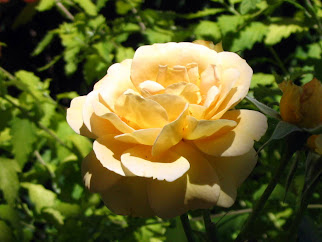
I’m in the middle of expanding one of my beds to make room for a beautiful yellow rose bush one of my daughters is growing tired of. How can you grow tired of roses?

Oh well, her loss, my gain.

It’s going to be a bit out of place for awhile because the area I’m putting it in is full of drought tolerant plants. It won’t stay there for more than a year or maybe two until I get its permanent spot prepared in the front yard. That’s going to be a major undertaking.


Speaking of loss and gain, is there nothing sadder than a tomato plant that has been struck down by frost?


Well, maybe a pepper plant.


Oh well, now it's off to plan next years garden.

Read more...

Done with Creeping, Ready for Leaping

>> Tuesday, June 23, 2009

According to the old garden adage: first year sleeps, second year creeps & third year leaps, my garden is about to leap. I’m not really sure what to make of this ‘leaping’ prediction but most of my plants survived winter, so, let the leaping begin.

At the beginning of the season there was a wonderful turnout of bulbs, (I just wish I had something like 1,000 more!). The daffodils put on their show and have since wilted away. The large wood hyacinths didn’t last much longer and when the new tulips burst forth they were center stage. I planted some new bulbs last fall that I had never grown before and I was, while not fully disappointed, I felt they could have done better.

Only a few Anemone Lord Lieutenant came up.


Camassia Quamash put on a good show:


Chionodoxa Forbesi Pink Giant did not do hardly anything, therefore I don’t have a
photo.


Iris Reticulata came up two weeks later than usual and didn’t last very long (of course these beauties never seem to last long enough). Here they are popping up behind Salvia East Friesland.


Ornithogalum Umbellatum did really well.


Here are some of the new tulips we planted last fall:
Catherina


Cri de Coeur


Saxatilis


I’m also pretty excited about all the vigorous growth from catmint, caryopteris (blue mist), lilacs, and groundcovers.

The catmint, Nepeta Walker’s Low, was the first to really get going (I love brushing against it when I’m weeding, the fragrance is amazing). Bees love it too.


Caryopteris Sunshine Blue started leafing-out on about the same day as the previous two years.


If I’m not mistaken, Dianthus Agatha and Desmond are a little larger this year, and photos confirm it.


Salvia East Friesland never disappoints.


Monarda Blue Stockings (bee balm) is leafing out, can’t wait to see it bloom again.


Clematis Jackmanii is really leaping this year.


Now, since the plentiful Spring rains have done their part to get everything blooming so beautifully, it’s time for me to do mine.

Read more...

Grass Clippings: Toss ‘em or Mulch ‘em?

One perpetual question homeowners deal with is what to do with grass clippings. Of course some people don’t worry about it, they just throw all clipping into the trash which adds to the growing problem of methane gas buildup at our landfills. They either don’t have a garden or don’t want to deal with a compost pile. Or, they just have too many weeds in their lawn.

Now, I have to admit I am one of those guys who actually enjoys mowing my lawn. It only takes me about an hour and it is an opportunity to examine the entire yard to see where there are problems developing. Also, I can see where weeds are becoming a problem around the flower and vegetable beds.

This year the issue hasn’t bothered me too much but its about to. What I have done with grass clippings so far is to spread them over a couple new beds I’m developing. You see it takes about a year before any new bed is ready to be planted in, that is using the method I do. There are quicker ways. Anyway, during that year I pile up the grass clippings on the planned beds and let them break down on their own. Occasionally, I’ll add some garden soil, some vegetable matter from the kitchen and some nitrogen fertilizer. But it is beginning to get to the point where those beds are getting pretty deep. I have been piling clippings along the fence on the west side of my yard to help keep down the amount of trimming I have to do with the string trimmer. It works to a point, and it is beginning to look like maybe I should build a new bed along the fence. It would be a great place to grow some flowering vines and some peas and beans.

I have learned that leaving clippings on the lawn does not create thatch as was once commonly believed and since I regularly aerate the lawn the build up of thatch is not a concern. That whole cycle of returning nitrogen and other nutrients back into the soil appeals to me. Plus, its that many fewer bags I have to haul away from the mower. At one point last year I collected nineteen bags of clippings! Usually early in the season, but OMG, I was amazed. Typically its seven to nine bags because I don’t regularly cut the lawn on a set schedule, anywhere from 8-11 days. The taller grass helps hold moisture in the soil and it seems to be working.

My lawn has plenty of earthworms as illustrated by the activity of Robins and Starlings pulling them up.

A couple of years ago, I learned that you should not place grass clippings on a compost pile if you have fed the grass within the previous two weeks. What I do with these is spread them over a concrete pad near the compost pile for a couple of weeks to dry it and then they can go on the pile.

So, toss ‘em or mulch ‘em? I’m going to start leaving them on the lawn and see what happens. Near the end of the year I’ll see whether or not any thatch has built up and go from there. Now, about starting new beds, I may have to ask some neighbors for their grass clippings.

Read more...

© 2007 -2011 - Utah Valley Gardens - All photos and content copyrighted by Utah Valley Gardens unless otherwise attributed. The use of photographs posted on this site without permission is forbidden and is protected by copyright law, as is all original text.

Blogger templates made by AllBlogTools.com

Back to TOP