Showing posts with label Caryopteris. Show all posts

Built new bed

>> Tuesday, October 16, 2007


Finally got this bed built. I have been planning this bed since we had the deck built two months after moving into this house in 2004.


Anyway, just finished it today and now I will need to have some soil delivered. It’s 14 ½’ long by 4’ front to back do that’s 58 sq ft. times 9” deep, so that’s, where’s my calculator, 522 cu ft. What? I must have done something wrong. D’oh! I mixed feet with inches. Try this again. 14.5’ x 4’ x .75’ = 43.5 cu ft. That sounds more like it. Wow, I used to be pretty good at math. Good thing there’s the internet to show me how. I found help at Do It Yourself.com.

Other raised beds I have built in the past I used wooden stakes at the corners. They have held up pretty well but this time I opted for metal strips at the corners


and to hold boards together.

Hopefully the weight of the soil won't push it apart at the seams.


I already have plants ordered for it,
Monarda (Bee Balm) Scarlet, an herb,


Hardy Lavender, also an herb,


Geranium Birches Double,


Daylily Stella de Oro,


Delphinium Blue Butterfly, a dwarf at 14" tall,


Phlox Blue Paradise,


and Dianthus Maiden Pinks.


This leaves room for a shrub at one corner and I haven’t decided between a Caryopteris or a Spirea. That corner will be in all day full sun so either one will do.

Read more...

Springhill Nursery order, part one

>> Tuesday, October 9, 2007


Received part of my order from Springhill Nursery. The backordered plant is a Dianthus Desmond, siz of them, actually.

The way they packed these shows, to me, that they really care about them arriving healthy and unblemished. The plants are all very well protected and they all are in very good condition. The instructions with that came with them said they are to go into the ground immediately. And, so they shall. When I unpacked them the root systems were very well developed. I will definitely order from Springhill Nursery in the future.


Caryopteris Summer Sorbet


at maurity

I have two other Caryopteris, Dark Knight and Sunshine Blue, that I planted in April of this year and I love their easy growth habit and the beautiful blue flowers all over them, at the ends of their long graceful stems. Sunshine Blue has light yellowish-green leaves that really dictates where you place the shrub, it just doesn’t look real good where it currently is so I have plans on moving it soon. The Dark Knight has darker green leaves that allows it to go next to just about any other plant. This one, Summer Sorbet, shares both foliage colorings and it may work in places the Sunshine Blue won’t. I’ll have to try it to see for myself.

They all tolerate some drought, perfect for my dry conditions here in Utah. Intolerant of wet, poorly-drained soils, so my clay has to be worked really well with compost and I am a little worried about this winter’s snowmelt. It will be a true test to how well I have compensated with the compost.

As long as the roots survive Caryopteris will come back and flourish. At any rate, they can take hard pruning each spring which will promote vigorous new stem growth. And all of the blooms come on new growth anyway.

They are commonly called Bluebeard, Blue Spirea, and Blue Mist. I’m not sure I have ever heard of them before this year but, so far, I’m glad I did. They make really lovely shrubs, at only 2’-3’ tall and wide, and make a really nice focal point to the border.

A bonus is that it is aromatic when brushed against and they all attract butterflies, bees and other beneficial insects. What more could you ask for in a shrub?


Sedum Improved Golden


at maturity

This one is billed as one of the finest ground covers for sunny dry slopes and banks. I don’t plan on using it on a slope or bank but my yard has no shortage of dry sunny places so it should fit in everywhere. I planted a Sedum Autumn Joy this spring which grew into what could best be described as a stalk of broccoli. I wasn’t real impressed but the pictures of it in full bloom told me to have patience. Once it bloomed, after the weather began cooling off, I knew I just have to have some more. The coloring started as a light pink and soon turned into a brilliant red that simply complimented nearly everything around it. I love this plant. I don’t see it being used as a groundcover because it grew to be 10” tall. I picture groundcover as being only a few inches tall and spreading outwards. Autumn Joy is a stalk but I plan on buying more anyway.

Then I saw this little beauty. And when I learned that I would not have to wait until fall to see the flowers I was sold. This one blooms in late spring and early summer and grows to only 5”-9” tall, which is more in line with my ideal of a groundcover, yet still a little tall. I bought six of them and hopefully they will spread quickly without being too invasive. It is described as a ‘hardy’ creeper which I am beginning to understand in garden nursery parlay means it is a bit invasive. It is to be spaced 12”-18” apart so there is another sign of its invasiveness. But it does have such beautiful yellow sumptuous flowers, doesn’t it?


Hollyhock Brilliant Miniature


at maturity

I have always liked the look of a bunch of Hollyhocks in bloom but their lankiness and the prospect of having to deal with plant supports in the middle of a flower bed put me off. These little guys only grow to be 30” tall and seem like they just might be what I was looking for. They bloom all through summer so they will add a splash of red anywhere I need it.

Aster Snowdrift


at maturity

My three Aster Alma Potschke plants steadily grew this summer into nice looking shrubs, patiently waiting until the weather cooled off, and then they simply burst into a beautiful mound of pink flowers, seemingly overnight. I was so impressed with their proliferation that when I saw these Snowdrift with their blizzard of delicate white daisies I knew the perfect place to show it off. I am going to place six of these in front of and surrounding my two brilliant red rose bushes. I can’t wait to see this combination next September and October.

They grow 4”-6” tall and spread 20”-24” so this is my idea of a groundcover. It is a care-free and very hardy selection of a native American wildflower that is a favorite with butterflies.

You just gotta love it.

Liatris White


at maturity

I planted a Liatris Kobold this spring that sadly did not survive our hot dry summer. I really like the non-standard shape of this plant. It just isn’t rounded or mounded or bushy like the typical perennial with its spikes that reminds me of cattails I used to see around the lake I grew up near as a kid. They weren’t white, of course, but there is something about the shape that I want in my garden. Besides I am not going to let these hot summers tell me I can’t have one of these so I will try it again and this time put some groundcover to keep its roots cool.

I was surprised to learn that Liatris is actually a bulb. Another surprise is that they bloom from the top down. Two more things that take it out of the realm of ordinary flowering plants.

They say you have to be careful with where you place white flowers for fear of it washing out the other colors but I am going to put five of these in a narrow strip along the north border of my property to help hide a chain link fence, interspersed with red Hollyhocks. They only grow 3’ tall and the fence is 7’ tall but it’s a start. I’m planning on putting some sort of a vine to grow along the top of the fence to help cover the rest of it. Maybe a honeysuckle.

Read more...

Scorecard: plants vs. me, part one

>> Friday, September 21, 2007

Well, it’s time for a critical look at what did and did not survive in my garden this year.s

This is the first time I have done this since this is my first year as a perennial flower gardener. So far, there are more survivors than fatalities, so I guess I am encouraged enough to continue into next year. Winter will be yet another test.

First, I will examine the backyard beds which are all on the north side of the house.

Here is bed B1, on the west side of the deck and against the south side of the house, as of Sep 21, 2007.


Admittedly, not a very good picture. I will need to replace it with another taken later in the day when the sun is to the west of the house.
The back of the house, when we first moved in was pretty stark. To get from the kitchen back door to the ground there was a porch of 6’ by 6’ solid concrete with three concrete steps down. This deck really changed the character of the yard and it created this ‘nook’ that I thought should be filled with shrubs and perennials. Future plans show a Hydrangea dominating the corner surrounded by Hosta and various other shade plants.

The plants I planted in this bed, over the course of the spring and summer, are:

Astilbe Amethyst (did not make it)
Caryopteris Dark Knight (did very well)
Hosta Golden Tiara (did not make it)
Hosta Piedmont Gold (barely survived)
Hydrangea Parzifal (did not make it)
Lamium White Nancy (did very well)
Marigold Petite Orange (did very well)


Caryopteris Dark Knight

I first heard of this plant this year and fell in love with it. It did so well that I bought two more. One of the others has light green foliage and to me looks a little anemic. Maybe it’s because of where it is planted. I have plans to move it. But this one looks great and bloomed like crazy. And the bees like it! The third one has variegated foliage and I can’t wait to see how it does.

Hosta Piedmont Gold

I don’t seem to be able to find much information on this particular variety. The flower is pale lavender and blooms mid-summer but the flower is not why anyone puts these in their garden. This location, on the north side of the house, is not ideal. It’s in bright shade until late afternoon when the sun reaches under the Peach tree for about two hours. I don’t know if that much sun was burning it or it isn’t getting enough water or the soil is staying too wet. The soil is clay but has had composted steer manure and bark mulch worked into last summer and again the Spring before planting it in May. The leaf tips are not the usual dried crispy brown that is a sure sign of lack of water, but rather they are flimsy as if they are too wet. This one is going to be real challenge to figure out. Once I do get it under control I want several other varieties because do have a wonderful variety of foliage.

Lamium White Nancy

This is spotted deadnettle and is really thriving in this location. It keeps sprouting white flowers all over it and then they disappear only to return again. The foliage is really great, it looks like it is frosted. There are three plants here and I guess I could have put them further apart.

Marigold Petite Orange

What else can be said about Marigolds? I put these here to help create some color because I knew this area would be empty all summer. I am really impressed with their bushiness and long lasting flowers. I haven’t ever pinched the blooms and they just are always there. I am taking this as a sign that they like the shade and the afternoon sun. I have other Marigolds elsewhere in the full sun all day and they aren’t as healthy as these.

The Astilbe, Hosta and Hydrangea all shriveled up and are barely recognizable as having been plants. The really weird part of this is that I planted these three plants, and the Hosta Piedmont Gold, all on the same day and they are all planted in the same location getting the same amount of water, food, and sunlight. There has not been any sign of insect or snail damage on any of them. Why did this one plant survive? Another one of those mysteries that make you go, hmmmm.


Here is bed B2, on the south side of the shed and on the east side of a wooden fence.


This bed consists mainly of Raspberry Heritage planted against the fence. I started with six plants in April of 2005 and they have since expanded into God knows how many. I have had to thin out quite a few to keep them in bounds. They only first produced this year (and they were worth the wait).

The Clematis Jackmanii, climbing up the trellis against the shed, was planted in April of 2006 and is doing well, except they did not bloom the whole year as expected. Last year it produced one lonely blossom at the end of June and was quite large, about 4” across. This year there were about 15 blooms that opened in late May, about the same size as last year, but only lasted for three weeks! The blossoms were darker than last year, and quite beautiful, but I thought they were supposed to last a lot longer.

This is the same bed that I had started a Rose floribunda Honey Perfume last year and it did so poorly that I transplanted it to one of the front yard beds where it survived and flourished.

In 2005, I planted some Plumbago along the shed that did not even last until the end of the summer. There are Daffodils, I planted in November 2004, that came up in ’05, ’06, and again this year just fine.

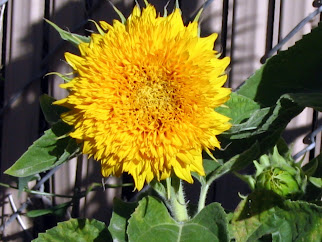
Out of frustration at trying to find something that will grow in that sunny, warm spot, I sowed about 20 sunflower seeds left over from a couple of packets I purchased in 2006.


Only three came up. I have heard that seeds are not likely to be viable for more than a year unless properly kept. I don’t know how to store them properly and I planted them knowing they may not be even sprout. Getting any of them to actually grow was a fluke.

Read more...

© 2007 -2011 - Utah Valley Gardens - All photos and content copyrighted by Utah Valley Gardens unless otherwise attributed. The use of photographs posted on this site without permission is forbidden and is protected by copyright law, as is all original text.

Blogger templates made by AllBlogTools.com

Back to TOP